

 Facebook
 X
 Pinterest
 Copy Link
There has never been more real estate information available to buyers and sellers.
Search for just about any question and you’ll find an answer. Mortgage rates, home values, whether it’s a good time to buy, whether you should sell now or wait, how much negotiating power buyers have, where prices are headed.
Between national real estate websites, social media, automated home valuations, and now AI, you can get an answer in seconds.
And I’ll admit it right up front: I use AI too.
It’s a useful tool. Sometimes an incredibly useful one.
But having more information doesn’t necessarily mean we’re getting better advice.
We don’t have an information shortage in real estate. We have a context shortage.
The National Housing Market Isn’t Your Housing Market
This is probably my biggest issue with a lot of the real estate content we see online.
A headline says inventory is increasing. Another says buyers have more negotiating power. Another says home prices are rising or falling.
All of those things can be true.
But what does any of it mean if you’re thinking about selling a home in Lynnwood? Or buying in Edmonds, Shoreline, Bothell, Kenmore, or Everett?
Even within South Snohomish and North King Counties, markets behave very differently.
A well priced home in a desirable neighborhood can still get immediate attention while another home a few miles away sits for weeks. A rambler may attract a completely different buyer pool than a two story home. Condition, lot, floor plan, updates, school district, street location, and even what else happens to be for sale that particular week can change the equation.
Anyone familiar with our local market knows that even within Edmonds, the Edmonds Bowl can behave very differently from other parts of the city.
That’s context you aren’t going to get from a national headline.
An Online Estimate Has Never Walked Through Your House
Automated valuations have gotten better. They’re useful as a starting point.
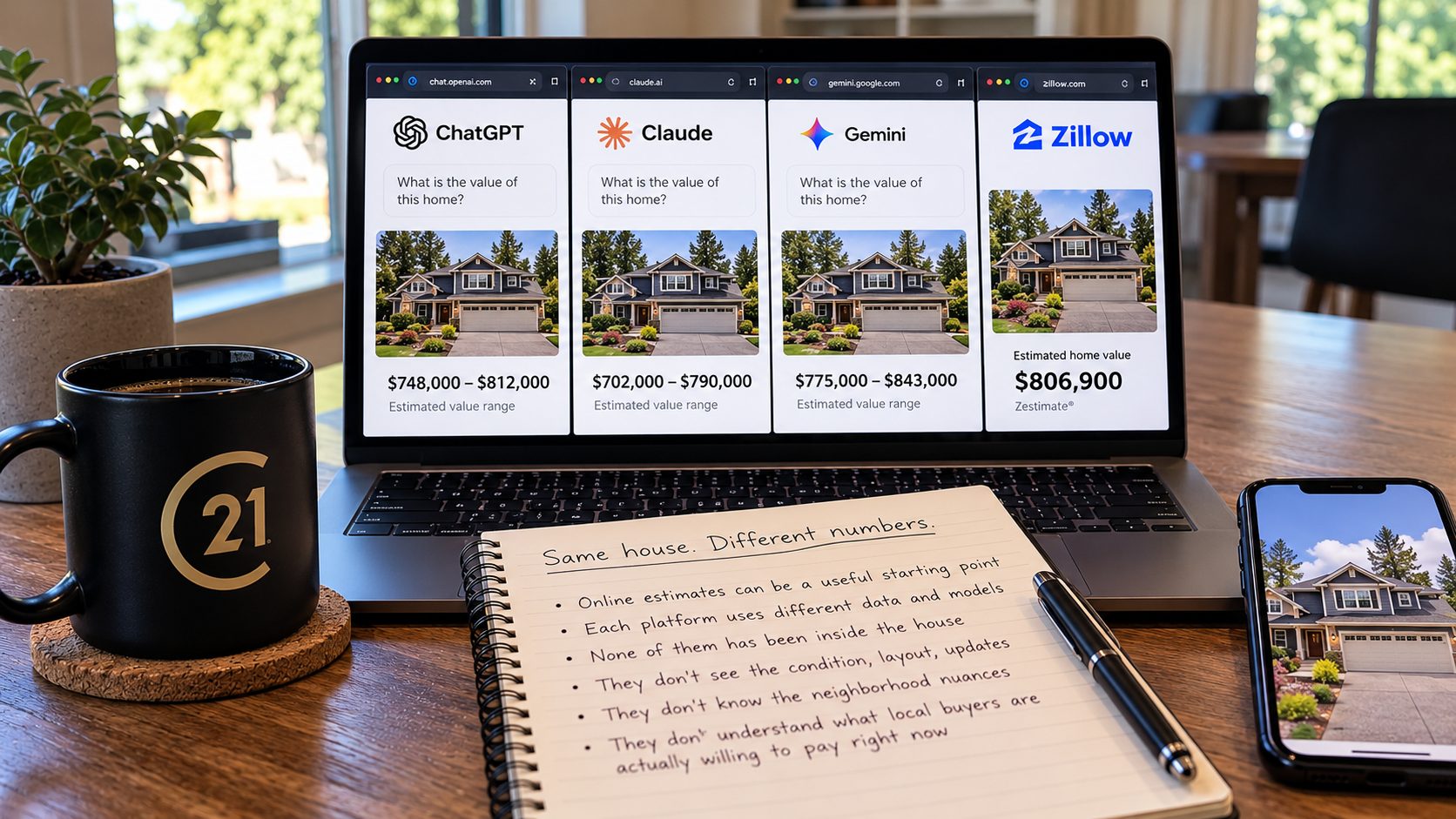
Here’s something worth trying sometime: look up your home on several different real estate websites and compare the estimated values. There’s a pretty good chance you’ll get several different numbers. Each platform uses its own data and valuation model, and none of them has actually been inside your house.
They don’t know that the kitchen looks considerably better in person than it does in the photos. They don’t know that the house next door backs to a busy road while yours doesn’t. They may not understand why buyers will pay more for one floor plan than another, or why two homes with almost identical square footage aren’t really comparable at all.
I run into this constantly when I’m pricing homes for sellers or analyzing properties for buyers.
The numbers matter. Comparable sales matter.
But why those homes sold for what they did matters just as much.
What AI Can Do, and What It Can’t
Whether you’re using ChatGPT, Claude, Gemini, or one of the many other AI tools available now, they can be genuinely helpful.
They can analyze sales data. They can explain market trends. They can help you understand financing or compare properties on paper. You can even ask one what you should offer on a particular house and probably get a pretty convincing answer.
But here’s where things change.
They haven’t been inside the house.
They didn’t see the remodel that looked great in the listing photos but felt completely different when you walked through the front door.
They don’t know that one rambler is likely to command a premium over seemingly similar nearby sales, or that the floor plan of another home is probably going to turn off a portion of the buyer pool.
They weren’t part of the conversation with the listing agent. They don’t know whether there might be flexibility behind that asking price, whether another buyer is circling, or why a previous transaction fell apart.
They weren’t at the open house watching buyers come through.
And they haven’t spent years watching buyers react to homes throughout South Snohomish and North King Counties.
ChatGPT, Claude, Gemini and the rest can give you information. They can even do a pretty good job helping you make sense of it.
What they can’t give you is the context that comes from actually being there.
Sometimes the Best Real Estate Advice Is “It Depends”
That’s probably not the most exciting answer on the internet, but real estate has a lot of “it depends.”
Should you offer below asking price?
It depends.
Should you make updates before selling?
It depends.
Is now a good time to buy?
It depends.
Should you wait until spring to list?
Again, it depends.
The useful part isn’t the answer. It’s what comes next:
What does it depend on?
Your goals. Your timeline. The property. The neighborhood. The competition. Recent sales. Current inventory. Buyer activity. Financing. And sometimes circumstances that are completely unique to you and have very little to do with the broader housing market.
That’s the conversation that gets lost when real estate advice is reduced to a headline, an algorithm, or a 30 second social media post.
More Information Isn’t the Same as Better Advice
I’m definitely not suggesting buyers and sellers stop researching.
Quite the opposite.
There are more great tools available today than we’ve ever had before. Use them. Ask questions. Look at homes online. Research neighborhoods. Read about the market. Ask AI questions.
An informed buyer or seller is a good thing.
But I think the value of a good real estate professional is changing.
It’s becoming less about having access to information and more about knowing which information actually matters.
Anyone can pull up recent sales.
The harder part is understanding which ones really tell us something about your home.
Anyone can read that buyers supposedly have more negotiating power.
The harder part is knowing whether you have negotiating power on the house you actually want to buy.
You can ask ChatGPT, Claude, Gemini, an automated valuation model, or any number of online tools what your home might be worth. And you might get a surprisingly good answer.
The harder part is knowing what an actual buyer is likely to pay for it after walking through the front door.
That’s the difference between information and context.
And in real estate, context can make a very expensive difference.
Thinking About a Move?
If you’re considering buying or selling in South Snohomish or North King County, do your research. Use the technology that’s available. Ask AI. Read the headlines. Look at the numbers.
Then let’s talk about how all of that information actually applies to your home, your neighborhood, and your situation.
Because your home isn’t a national housing statistic, and your next move shouldn’t be based on one.

